Günther Bornkamm's treasures

Caravaggio-The_Conversion_on_the_Way_to_Damascus_40p.jpg
Can I just say that Günther Bornkamm's books on Jesus of Nazareth and Paul are brilliant. I am no theologian and thereby not someone properly able to contextualise them in terms of their theological scholarship. Having said that I can not but appreciate them as excellent all-around expositions of the central politico-theological commitments of both Jesus and Paul. I found Bornkamm via an almost flattering citation by Alan Badiou in his Saint Paul.


While one of the purposes of the book on Jesus is to make his message as powerful and relevant today as it was two thousand years ago, Bornkamm acknowledges that messianism often gets hijacked in our secular age. He points his finger at

the front of fanatics who wish to claim Jesus for their own as the great revolutionary, as the prophet of a new world order, as the bringer of a new era, to which must be sacrificed all that is gone before, the word of God in the law and prophets. [...] This movement rushes towards a dreamed-of future, right past the law of God and heedless of it. We have met this tendency in many different forms in the course of a long and changing history. More than that! Its threat is still with us. (JON, 101.)


Writing in the late 1950s he is talking about revolutionary marxism, of course. Fifty years have passed and the threat of secular messianism is still with us, would you not agree?

The book on Paul is the best one I have read thus far on the man. It is a book of two halves: one on the historical Paul, his background, dramatic conversion, and apostolic credentials. I can tell most of the arguments made here are far from conventional. I can also tell where Bornkamm's reading inspired Badiou. Saint Paul reads almost like an unbeliever's ending to Paul: one that writes him off as a politician rather than an apostle.

The second half is on the theology of Paul's letters. One of the things I found interesting here was how Bornkamm distances pietism from pauline theology. Paul's view of the human condition does not make the presumption that man experiences his lost state, from which the Law is powerless to deliver him:

Paul's thought and preaching do not therefore follow the logic of the preaching and practice of repentance as seen especially in pietism. There, in disregard of the gospel, men are shown the depth of their sin, and every effort is made to bring them to despair of themselves [...] When Paul expounds the saving good news, it is generally in statements summarily characterizing man's state as lost; and this is not an evolutionary stage now left behind, on which he can look back with a sigh of relief. (P, 121, emphasis in original.)


It will be interesting to learn how laestadian theologians read Paul in this context.

Mika

Wordclouds of the Bible

Gene Veith posts an excellent link:


You must see Sixty-Six Clouds, which gives wordclouds (computerized breakdowns of word frequency with the most used words given in proportionally larger fonts) for each book of the Bible.


Here is the Psalms:

Psalms wordcloud


Here is Luke:

Luke wordcloud


Here is Romans:

Romans wordcloud


What I am wondering is how can one use wordclouds as a research tool? Not only scripture, I mean, but any text really. This is a form of discourse analysis, I suppose, and seems more useful than a good number of discourse analyses I have read up to this date.

(Via Cranach: The Blog of Veith.)


Mika

Luthers Christmas Sermons

Excuse me for posting another on Christmas eve, but this is a good one. Season's sermons from our reformer:

Luther's Christmas Sermons Epistles by J.N Lenker

Martin Luther's Christmas Book By Roland H. Bainton

Sermon for the First Sunday in Advent, Matthew 21:1-9 -- Christ's Advent into Jerusalem

Sermon for the Second Sunday in Advent, Luke 21:25-36 -- The Signs of Christ's Second Coming

Sermon for the Third Sunday in Advent, Matthew 11:2-10 -- a marvelous sermon with a great section on the distinction between Law and Gospel.

Sermon for the Fourth Sunday in Advent, John 1:19-28 -- John the Baptist's confession and the true preacher.

Sermon for the First Sunday in Advent, Romans 13:11-14 -- An Exhortation to Good Works

Sermon for the Second Sunday in Advent, Romans 15:4-13 -- An Exhortation to Bear with the Weak

Sermon for the Third Sunday in Advent, 1 Corinthians 4:1-5 - A sermon on the Office of the Ministry

Sermon for the Fourth Sunday in Advent, Philippians 4:4-7 - A sermon on Christian living; 'on how to let God be everything to us'; with sections on true Christian freedom, rejoicing, and prayer.

Sermon for the Principal Christmas Service, John 1:1-14 -- Christ's Titles of Honor and His Attributes

Sermon for the Early Christmas Day Service, Luke 2:15-20 -- A sermon on the power and fruit of the Word of God

Sermon for Christmas Day, Luke 2:1-14 -- One of Luther's most famous sermons.

Sermon for Christmas Eve, Titus 2:11-14 -- Luther at his best

Second Sermon for Christmas Day, Titus 3:4-8 -- Statements on grace, faith, good works, and Baptism

Sermon for the Sunday after Christmas, Luke 2:33-40 -- On Simeon and Anna

Sermon for the Sunday after Christmas, Galatians 4:1-7 -- The People of Law and Grace; a great sermon that presents the true understanding of justification by faith and the function of the Law; Of interest to the JDDJ debate is this quote: 'Note, Paul everywhere teaches justification, not by works, but solely by faith; and not as a process, but instantaneous. The testament includes in itself everything--justification, salvation, the inheritance and great blessing. Through faith it is instantaneously enjoyed, not in part, but all' (par. 37).

Sermon on the Afternoon of Christmas Day Luke 2:1-14, December 25, 1530

The Story of Jesus' Birth: A Sermon by Martin Luther- The great theologian's powerful reimagining of the Christmas story.

‘To Us a Child Is Born’: Sermon on Isaiah 9:6 (PDF)


(Via Beggars All: Reformation And Apologetics.)


Mika

Christmas in the Trenches

Peace from your editor and a classic piece, Christmas in the Trenches, by Jim Wallis:


We first published this reflection by Jim Wallis in 2002. It has since become our Christmas tradition, kind of our own
Charlie Brown Christmas special, if you will. With the ongoing conflicts raging during each passing year, it remains tragically relevant,…

(Via God's Politics Blog.)


Mika

People: good or evil?

Dennis Praeger cuts into the heart of the matter of political theory by asking the perennial question: If You Believe People Are Basically Good or Evil?

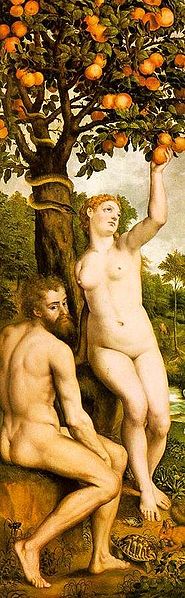
185px-Original_Sin_Michel_Coxcie.jpg

According to Praeger no issue has a greater influence on determining your social and political views than whether you view human nature as basically good or not:

I believe that we are born with tendencies toward both good and evil. Yes, babies are born innocent, but not good. Why is this issue so important? First, if you believe people are born good, you will attribute evil to forces outside the individual.


One of these forces is poverty, which explains evil by social deprivation. The fallacy of this explanation is, Praeger points out, that there are people who choose evil for reasons having nothing to do with their economic situation.

He goes on:

Second, if you believe people are born good, you will not stress character development when you raise children. [...] You will teach them how to struggle against the evils of society -- its sexism, its racism, its classism and its homophobia. But you will not teach them that the primary struggle they have to wage to make a better world is against their own nature.


This is what religion teaches, at least the Christian religion does. Mankind is with Adam: we are, like St. Paul, "of the flesh, sold under sin" (Rom 7:14, ESV). If there is something wrong with the society, it is not the society: it is us. It is not the structure we must blame, but the agent.

Praeger continues with two more important points, but we already know where he is coming from. I have always admired the eloquence of the conservative genre: conservatives do not need to quote research or theories to make a point. An argument composed in layman's black/white, either/or, friend/enemy terms communicates more than social science ever could.

Where have I read Praeger's question before? In Carl Schmitt's The Concept of the Political, of course:

One could test all theories of state and political ideas according to their anthropology and thereby classify these as to whether they consciously or unconsciously presuppose man to be by nature evil or by nature good. [...] The problematic or unproblematic conception of man is decisive for the presupposition of every further political consideration, the answer to the question whether man is a dangerous being or not, a risky or harmless creature. (58.)


A theologian ceases to be a theologian, Schmitt argues, when he no longer considers man to be a sinner in need of redemption, no longer distinguishes between the chosen and unchosen. When you first entertain the thought that people can be good, you will soon believe that you yourself are good. Those who disagree with your assessment -- and there will always be someone -- are not merely wrong, but likely to be on the evil's side. Theology works as a bulwark against moral relativism: a stand on God's good against the ideas and ideologies of men.

Praeger finishes off by demolishing the ideological foundations of "secular humanistic culture":

No great body of wisdom, East or West, ever posited that people were basically good. This naive and dangerous notion originated in modern secular Western thought, probably with Jean Jacques Rousseau, the Frenchman who gave us the notion of pre-modern man as a noble savage. He was half right. Savage, yes, noble, no. If the West does not soon reject Rousseau and humanism and begin to recognize evil, judge it and confront it, it will find itself incapable of fighting savages who are not noble.


In other words: political society needs God on its side. Where have I read this before? Joseph de Maistre is about as pessimistic when it comes to the faculties of man in taking care of its political institutions. Considerations on France is an attack on Rousseau -- "perhaps the most self-deceived man who ever lived" -- and the revolution he helped inspire. De Maistre abhorred the idea of state apart from the divine:

It would be curious to examine our European institutions one by one and to show how they are all Christianized, how religion mingles in everything, animates and sustains everything. Human passions may pollute and even pervert primitive creations, but if the principle is divine, this is enough to give them a prodigious permanence. (42.)


Though I agree with Praeger when it comes to his (and Schmitt's) anthropological assessment, I find it difficult to bring it into our political context. Both de Maistre and Praeger write in their own political contexts -- Joseph against revolutionary humanism and Dennis against American liberalism -- and their conclusions have little to contribute to, say, Finland in the current political moment. What (or who) is evil in Finnish society? Is God on Finland's side, and if indeed he is, who are the Finns exactly? If not on "our" side, whose side is God on?

(Via Apologetic Junkie.)

Mika

Eating, drinking and sleeping political theology

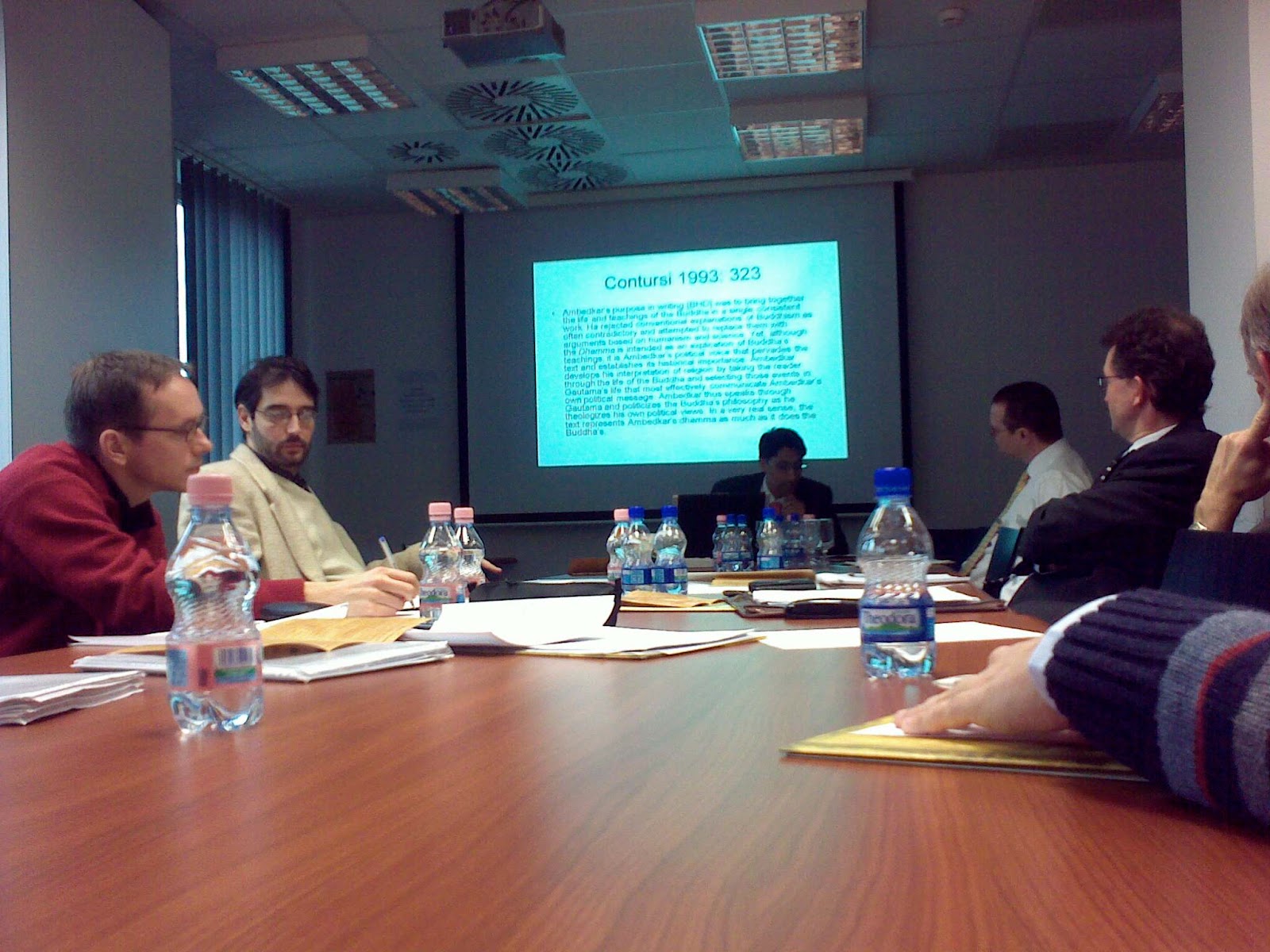
The International Research Network on Religion and Democarcy (IRNRD) held its annual conference on 14.-15.12.2009 at the Corvinus University in Budapest, Hungary. The theme of the conference was Political Theology for the 21st Century: Trends and Tasks. Among speakers invited were Lieven Boeve (Catholic University Leuven), Michael Hoelzl (University of Manchester), Peter Jonkers (Tilburg University), András Lánczi (Corvinus University) and Theo de Wit (Tilburg University). I gave a talk on the laestadian movement in Finland and presented an outline of our research project.

14122009106.jpgFrom the left: Tom Bailey (John Cabot University), Peter Losonczi (University of West Hungary), Aakash Singh (LUISS University Rome), David Tombs (Irish School of Ecumenics, Trinity College Dublin), Lieven Boeve, Peter Jonkers and the hand of Domenico Melidoro (LUISS University, Rome).

The venue of the conference was faithful to its theme. The participants stayed at Kálvin Ház -- A hotel in downtown Budapest I can warmly recommend -- and the conference dinner was served in Spinoza Restaurant:

14122009115.jpg

Well done by the organizers! Corvinus University itself was originally established to honour Karl Marx, whose politico-theological relevance may appear less obvious.

My first meeting with the network can only be described as a massive succé! It was indeed a privilege to work with such an esteemed line-up of colleagues. My notes are rich with interesting excursions into new political theologies and intriguing ideas to work with over the next couple of years. Thanks again for Peter Losonczi and Akaash Singh for their effort and for inviting me along. Next year’s meeting will be held in Rome and we are planning to bring the network to Rovaniemi in 2011 or 2012. Excellent stuff!

Mika

Political dimensions of the Laestadianism in the research focus funded by Academy of Finland

Thanks freepathways for the heads-up:

Political dimensions of the Laestadianism in the research focus funded by Academy of Finland: "


The Academy of Finland’s Research Council for Culture and Society has recently decided to fund a new research project on Laestadianism from the political point of view:  Laestadian-ism: Political Theology and Civil Religion in Secularizing Finland. The project  will be managed  by Dr. Mika Luoma-aho (Assistant Professor of International Relations, University of Lapland), to the tune of 375,000 Euro over the period 1 January 2010 through 31 December 2012.
The research project is welcome and important  in this global situation. We need more understanding about both national and international religional movements, especially about their societal and political roles and impacts.  It is expectable that the results of the project will be appreciated by the researcers and the field of the practice in the society, especially in Finland where the Laestadian movement is a largest, powerful separatistic movement in the The Evangelical Lutheran Church of Finland.


(Via Omat polut - etnisten vanhoillislestadiolaisten kertomuksia ja kokemuksia.)


Mika