Showing posts with label mika. Show all posts

LEARNING TO LIVE FREE: Minnesota Laestadian Sex Abuse Case

Apparently -- and indeed unfortunately -- laestadian abuse cases are not confined to Finland. Learning to Live Freereports of a case in the OALC in Minnesota:

Minnesota Laestadian Sex Abuse Case: "Apparently sex abuse is still happening in Laestadian circles in the United States as well, as attested to in this article regarding a case that hit the news last July involving a volunteer at the Old Apostolic Lutheran Church on Rowland Road in Minnetonka, Minnesota."


AFAIK the Finnish press has thus far failed to notice this case. Päivi Räsänen keeping the religion beat busy I suppose.

Mika

The Biopolitics of Development: A Symposium at September 9--10 at Kolkata, India

Keynote Speakers

- Michael Dillon (Sehir University, Turkey)
- Manas Ray (CSSSC, India)
- Julian Reid (University of Lapland, Finland)
- Ranabir Samaddar (Calcutta Research Group, India)

Organized by the University of Lapland and the Calcutta Research Group. Funded by the Finnish Academy

How can we understand the historical and contemporary function of development doctrine in the propagation and expansion of liberal regimes of governance? How has the strategic function of development changed in the transition from liberal to neoliberal rationalities of governance? And what is the relevance of the shift from development to sustainable development for the increasingly global hegemony of neoliberalism? Answering these questions requires examining the fundamental and complex correlations of economy, politics and security with life in liberal doctrine. For it is the reification of life which has permitted liberalism to proliferate, like a poison species, taking over entire states and societies in the wake of their disasters, utilizing their suffering, as conditions for its spread, installing markets, commodifying anything it can lay its hands on, monetizing the value of everything, driving peoples from countryside into cities, generating displacement, homelessness, and deprivation.

Neoliberalism is widely understood as a theory of political economic practices proposing that human well-being can best be advanced by the maximization of entrepreneurial freedoms within an institutional framework characterized by private property rights, individual liberty, unencumbered markets, and free trade. Less understood, however, is how its claims to be able to increase wealth and freedom became correlated with claims to increase the prosperity and security of life itself. For life was triangulated with capital and labour within liberal regimes of governance from the very earliest emergence of liberal political economy’s competition and conflict with the Cameralism and Mercantilism of Polizeiwissenschaft. Life, in the form of species existence, rather than nature, specifically the political and economic nature in particular of rational Man whose dual nature derived much more from European scholasticism than many of its early modern proponents conceded, has progressively emerged as a singularly important a priori for liberal political economy.

Neoliberalism breaks from earlier liberalisms and traditions of political economy in so far as its legitimacy rests on its capacities to correlate practices for the increase of economic profitability and prosperity not just with practices for the securing of the human species, but with the life of the biosphere. These correlations of economy, well-being, freedom, security and biospheric life in and among neoliberal regimes of practice and representation comprise some of the foundations of its biopolitics. As this symposium will explore, we cannot understand how liberalism functions, most especially how it has gained the global hegemony that it has, without addressing how systematically the category of life has organized the correlation of its various practices of governance, as well as how important the shift in the very understanding of life, from the human to the biospheric, has been for changes in those practices. Today it is not simply living species and habitats that are threatened with extinction, and for which we must mobilize our care, but the words and gestures of human solidarity on which resistance to biopolitical regimes of governance depends. A sense of responsibility for the survival of the life of the biosphere is not a sufficient condition for the development of a political subject capable of speaking back to neoliberalism; nor a mere humanistic sense of responsibility for the life of human amongst other beings. What is required is a subject responsible for securing incorporeal species, chiefly that of the political, currently threatened with extinction, on account of the overwrought fascination with life that has colonized the developmental as well as every other biopoliticized imaginary of the modern age.

This symposium seeks to explore a range of responses to this problematic. It invites papers from across the disciplines and from a variety of theoretical perspectives that address any aspect of the biopolitics of development. This will be a two-day symposium with about 20-25 participants marked by presentation of views, papers, roundtable discussions, and question-answer sessions. Paper proposals aiming to respond to this problematic should be submitted to Julian Reid (reidjulian@gmail.com) and Ranabir Samaddar (ranabir@mcrg.ac.in).

Deadline: July 31, 2010.

Political theology in Rome

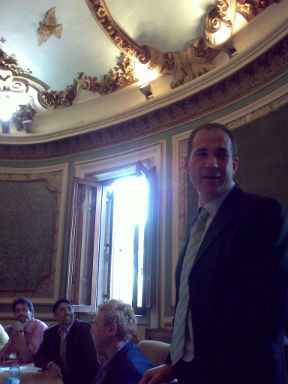
Your editor reports from Rome, Italy, where he attended the meeting of the executive committee of the International Research Network on Religion and Democracy (IRNRD). The meeting was preceded by lectures of Dr Michael Hölzl (Manchester, pictured below giving a brilliant lecture on the temptation of re-mythologising sovereignty), prof Graham Ward (Manchester), and Walter Van Herck (Antwerp). The meeting and lectures were kindly hosted by the LUISS Centre for Ethics and Global Politics and John Cabot University.

30.04.2010-14.08.44_26042010166_288x384.jpg


Let it be known that Rome is certainly one of the great cities of the world and both LUISS and JCU extraordinary academic institutions. The committee meeting was also a success: the IRNRD 2010 conference takes place in Rome under the title "Between Rawls and Religion". The following conference on "Politics and Evil" will meet at the University of Lapland in December 2011 -- i.e. we decided to move the Lapland meeting one year earlier than previously planned.

Thanks again Aakash and Tom for hosting us. Looking forward to working with you again soon.

Mika

The New Pietism Will Lead to The Same Old Results

The lutheran blog Cyberbrethen posts an interesting tidbit on pietism from a book published two decades ago: The New Pietism Will Lead to The Same Old Results:

‘We do not have to look very far to see that today there is a new spirit of pietism abroad, a pietism that sees the essence of Christianity in the small, informal group, rather than in the total community of faith at worship within a recognized and formal liturgical order. It is a pietism that measures its success by the number of people it touches, rather than by the truth of the message it proclaims. It is a pietism that is preoccupied with ‘simple hymns’ and informal structures of worship. It is a pietism that is impatient with the German Reformation of the sixteenth century, a pietism that asserts that we need new forms and less of the old. It is a new spirit of pietism that looks in many respects like the old pietism, the Pietism in the technical sense which we have considered here. (Bach and Pietism: Similarities Today, by Robin A. Leaver, Concordia Theological Quarterly, 55:1 (Jan. 1991), pp. 5-22.)


(Via Cyberbrethren Lutheran Blog.)


Mika

Thinking about humanitarian responsibility

E2FD60B6-D241-422F-8DC3-3F236B6989A9.jpg


I am currently writing a paper/book chapter on humanitarian responsibility, commenting the UN's Millennium Declaration from a politico-theological perspective. There is lots to comment, but I am currently stuck to thinking and writing about the second article:

We recognize that, in addition to our separate responsibilities to our individual societies, we have a collective responsibility to uphold the principles of human dignity, equality and equity at the global level. As leaders we have a duty therefore to all the world’s people, especially the most vulnerable and, in particular, the children of the world, to whom the future belongs.


The leaders identify two kinds of responsibility here. On the one hand they are responsible to their national "constituency": this one is fairly straightforward. The other kind is trickier: a collective responsibility to uphold human dignity, equality and equity at the global level. How does such a responsibility come about? Is responsibility something we humans must accept as a premise, or rather something we have agreed upon and must now accept on that basis?

The way I look at this we have two options to conceive humanitarian responsibility. We can give human life a "true" meaning, i.e. that human life now is just as precious as it was, say, two thousand years ago. This is the ideal that all the declarations and human rights legislation reflect. If we do not like "true" meaning we have to accept that it is a relative thing: what it means to be human depends on convention, and its meaning can be different in different time and place. Two thousand years ago there were no human rights, so the people then were not human, or they had no rights, or both.

What it boils down to us this: either humanitarian responsibility has an ultimate basis or it does not have such a basis. If we accept true meaning we can do so only from a theistic worldview. If we reject it we must accept the fact that we are no more than what we make of ourselves: biological creatures, who came up with an idea of "humanity". As simple as that.

Mika

Laestadianism and charismatic christianity?

At the end of my interesting and increasingly useful excursion to The United States I had a privilege of meeting an English pastor with whom I got a chance to speak (among other things) laestadianism. My friend was interested in charismatic Christianity and was on related trip to the US, visiting a church in Redding, CA.

Laestadianism has its roots firmly in the charismatic tradition, based as it is in the powerful person and preaching of Lars Levi Laestadius in 19th century Lapland. I am no expert in church history, but I do have some doubts about identifying the contemporary movement as charismatic. There are charismatic Christian sects in Finland, like the Nokia Revival, but in the practice of the laestadian religion there is little or no emphasis on spiritual gifts or godly manifestations.

Disagree? Let me know in the comments.

Mika

Two brothers, one atheist and the other Christian

Christopher Hitchens is currently one of the major "evangelists" of (the so-called) new atheism. His brother Peter, another British journalist, used to be an atheist not unlike his brother, but converted to Christianity. The Daily Mail interviews Peter Hitchens in a must-read piece titled How I found God and peace with my atheist brother.

P. Hitchens makes an argument worth thinking about:

Why is there such a fury against religion now? Because religion is the one reliable force that stands in the way of the power of the strong over the weak. The one reliable force that forms the foundation of the concept of the rule of law.
The one reliable force that restrains the hand of the man of power. In an age of powerworship, the Christian religion has become the principal obstacle to the desire of earthly utopians for absolute power.


I need to check out his new book The Rage Against God.

(Via Gene Veith.)

Mika

Millenarianism in The Big Easy

Your host will be on the road again for the next three weeks or so. I am currently working FT on professor Julian Reid's research project, Governing Life Globally, also funded by the Academy of Finland. I am heading to the United States this time.

My first destination is the ISA's 51st annual convention in New Orleans, Louisiana. I am presenting a paper on the political theology of the United Nation's Millennium Development Goals. I am staying at a hotel in the city's historical French Quarter. ISA is not the only game in town this week, as it is also time for Mardi Gras!

Orleans.bourbon.arp.750pix.jpg


After the convention I will head to Northern California to visit UC at Berkeley and Davis and meet some colleagues over there.

I am riding with my laptop so email me with any developments. Mari is also standing by at the Laestadian-ism project headquarters -- we prefer to call it the LHQ -- and you will reach her at 'laestadianism' in Google's popular mail address. I will back on March 10th or so.

Meanwhile: fight the good fight!

Mika

Pedophilia?

The laestadian community in Finland is currently in the midst of a pedophile scandal. A prominent Pietarsaari preacher of the Word of Peace-community allegedly abused more than ten of his grandchildren in the 1970s and 80s. The accused has since passed away and the blame is now laid on the parents, who not only tolerated the abuse of their children but helped to cover it up for decades.

RIL News -- a bilingual Finnish news aggregator advocating a Christian worldview -- is monitoring the story here. Helsingin Sanomat is also following up (in Finnish) by reporting on the fallout of the scandal in Pietarsaari: children turning against their parents and local politicians reporting each other to the police.

What the media is making out of this case is the Roman Catholic sex abuses writ small.

Mika

Peacekeeper's prayerbook in Siuntio

Your editor will be on the road again 15.--16.1.2010 as he attends the 3rd conference of the Finnish International Studies Association (KATSE) in Siuntio, Finland. I will present an abstract of a paper I am currently outlining (in Finnish) on the Peacekeeper's Prayerbook -- indeed an interesting politico-theological document produced by the Finnish Defence Forces.

Tried to google for something that would address UN's peacekeeping from a theological perspective, and just about the only title to turn up is the doctoral dissertation by a Finnish theologian Timo Ryhänen: Spirituality of Finnish Peacekeepers (University of Helsinki, Faculty of Theology: 2006).

If I am missing something obvious let me know in the comments.

Mika

Greetings and a good blog FYI

It's 2010 and we are officially up and running. As of 1.1.2010 the project employs Tapio Nykänen; Sandra Wallenius begins on 1.4.2010, and rest of the team will join them later. All the researchers employed by the project will contribute to this blog: tell us about their research and comment on topical issues regarding laestadianism and political theology/religion in general.

The Prosblogion is a blog on the philosophy of religion I just added on Lars' blogroll. Looks like like quality posts and regular updates. If you are interested in the current debates in theism/atheism and apologetics, go have a look.

Mika

Luthers Christmas Sermons

Excuse me for posting another on Christmas eve, but this is a good one. Season's sermons from our reformer:

Luther's Christmas Sermons Epistles by J.N Lenker

Martin Luther's Christmas Book By Roland H. Bainton

Sermon for the First Sunday in Advent, Matthew 21:1-9 -- Christ's Advent into Jerusalem

Sermon for the Second Sunday in Advent, Luke 21:25-36 -- The Signs of Christ's Second Coming

Sermon for the Third Sunday in Advent, Matthew 11:2-10 -- a marvelous sermon with a great section on the distinction between Law and Gospel.

Sermon for the Fourth Sunday in Advent, John 1:19-28 -- John the Baptist's confession and the true preacher.

Sermon for the First Sunday in Advent, Romans 13:11-14 -- An Exhortation to Good Works

Sermon for the Second Sunday in Advent, Romans 15:4-13 -- An Exhortation to Bear with the Weak

Sermon for the Third Sunday in Advent, 1 Corinthians 4:1-5 - A sermon on the Office of the Ministry

Sermon for the Fourth Sunday in Advent, Philippians 4:4-7 - A sermon on Christian living; 'on how to let God be everything to us'; with sections on true Christian freedom, rejoicing, and prayer.

Sermon for the Principal Christmas Service, John 1:1-14 -- Christ's Titles of Honor and His Attributes

Sermon for the Early Christmas Day Service, Luke 2:15-20 -- A sermon on the power and fruit of the Word of God

Sermon for Christmas Day, Luke 2:1-14 -- One of Luther's most famous sermons.

Sermon for Christmas Eve, Titus 2:11-14 -- Luther at his best

Second Sermon for Christmas Day, Titus 3:4-8 -- Statements on grace, faith, good works, and Baptism

Sermon for the Sunday after Christmas, Luke 2:33-40 -- On Simeon and Anna

Sermon for the Sunday after Christmas, Galatians 4:1-7 -- The People of Law and Grace; a great sermon that presents the true understanding of justification by faith and the function of the Law; Of interest to the JDDJ debate is this quote: 'Note, Paul everywhere teaches justification, not by works, but solely by faith; and not as a process, but instantaneous. The testament includes in itself everything--justification, salvation, the inheritance and great blessing. Through faith it is instantaneously enjoyed, not in part, but all' (par. 37).

Sermon on the Afternoon of Christmas Day Luke 2:1-14, December 25, 1530

The Story of Jesus' Birth: A Sermon by Martin Luther- The great theologian's powerful reimagining of the Christmas story.

‘To Us a Child Is Born’: Sermon on Isaiah 9:6 (PDF)


(Via Beggars All: Reformation And Apologetics.)


Mika

Christmas in the Trenches

Peace from your editor and a classic piece, Christmas in the Trenches, by Jim Wallis:


We first published this reflection by Jim Wallis in 2002. It has since become our Christmas tradition, kind of our own
Charlie Brown Christmas special, if you will. With the ongoing conflicts raging during each passing year, it remains tragically relevant,…

(Via God's Politics Blog.)


Mika

Eating, drinking and sleeping political theology

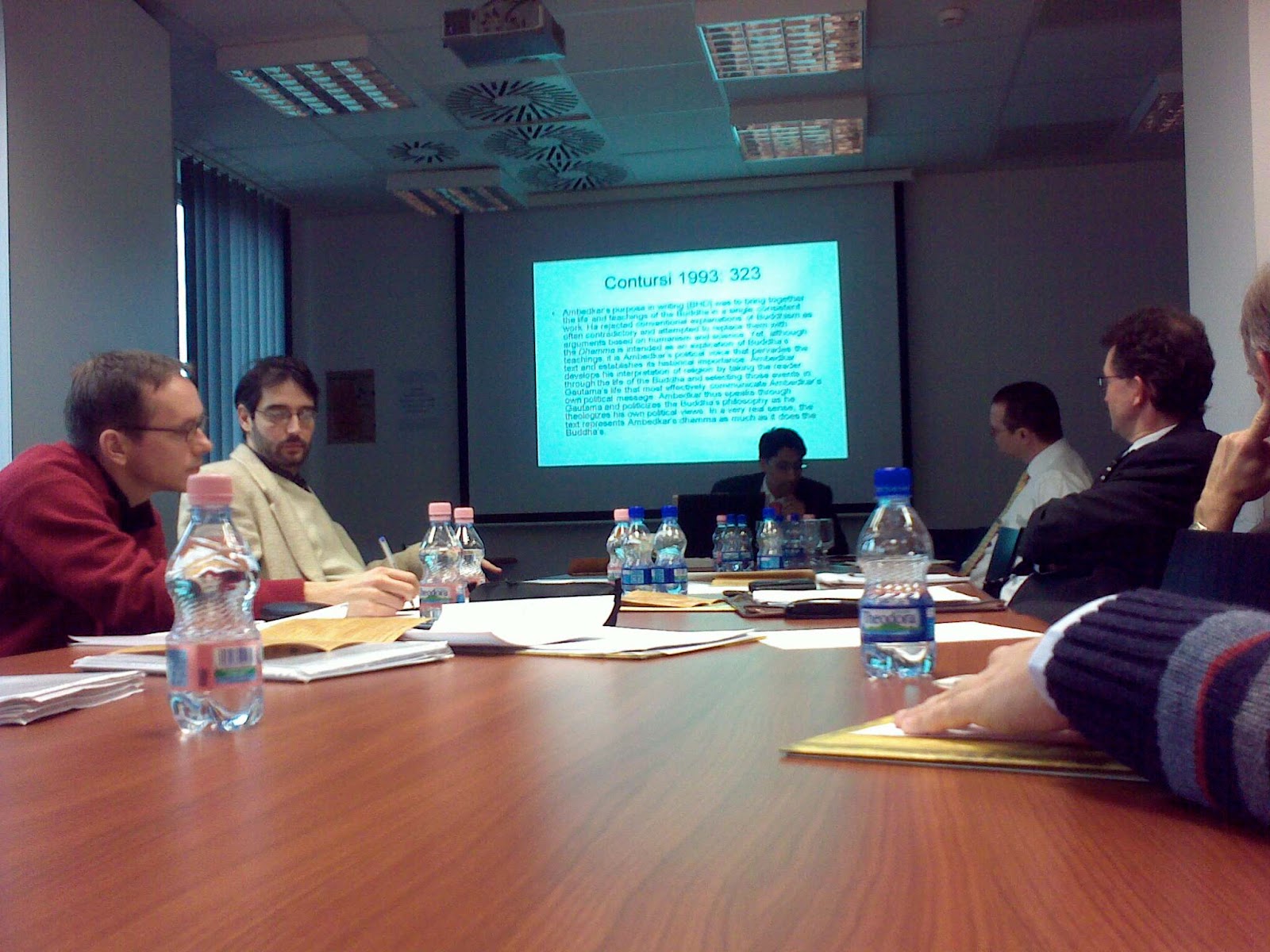
The International Research Network on Religion and Democarcy (IRNRD) held its annual conference on 14.-15.12.2009 at the Corvinus University in Budapest, Hungary. The theme of the conference was Political Theology for the 21st Century: Trends and Tasks. Among speakers invited were Lieven Boeve (Catholic University Leuven), Michael Hoelzl (University of Manchester), Peter Jonkers (Tilburg University), András Lánczi (Corvinus University) and Theo de Wit (Tilburg University). I gave a talk on the laestadian movement in Finland and presented an outline of our research project.

14122009106.jpgFrom the left: Tom Bailey (John Cabot University), Peter Losonczi (University of West Hungary), Aakash Singh (LUISS University Rome), David Tombs (Irish School of Ecumenics, Trinity College Dublin), Lieven Boeve, Peter Jonkers and the hand of Domenico Melidoro (LUISS University, Rome).
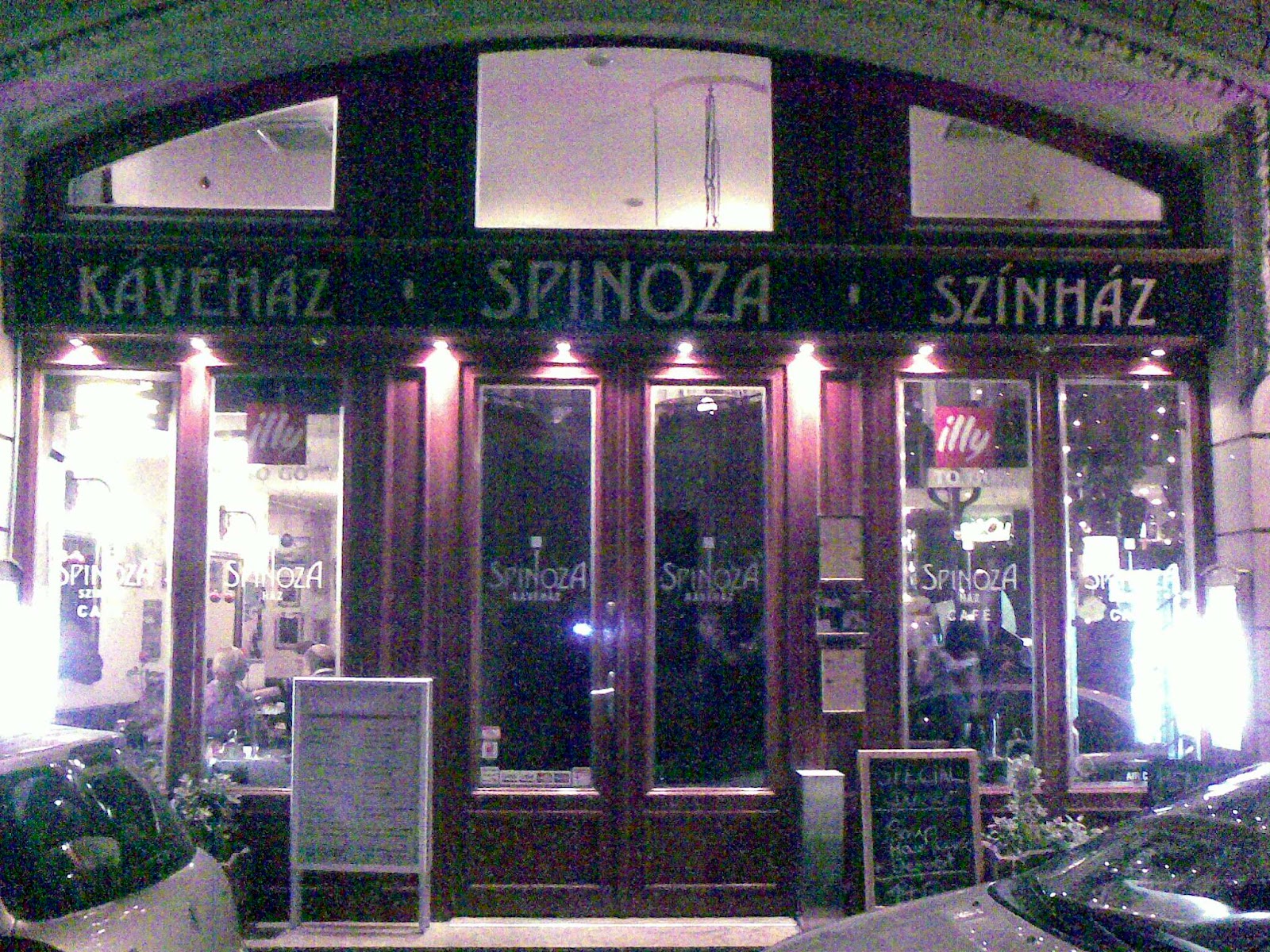
The venue of the conference was faithful to its theme. The participants stayed at Kálvin Ház -- A hotel in downtown Budapest I can warmly recommend -- and the conference dinner was served in Spinoza Restaurant:

14122009115.jpg

Well done by the organizers! Corvinus University itself was originally established to honour Karl Marx, whose politico-theological relevance may appear less obvious.

My first meeting with the network can only be described as a massive succé! It was indeed a privilege to work with such an esteemed line-up of colleagues. My notes are rich with interesting excursions into new political theologies and intriguing ideas to work with over the next couple of years. Thanks again for Peter Losonczi and Akaash Singh for their effort and for inviting me along. Next year’s meeting will be held in Rome and we are planning to bring the network to Rovaniemi in 2011 or 2012. Excellent stuff!

Mika

Political dimensions of the Laestadianism in the research focus funded by Academy of Finland

Thanks freepathways for the heads-up:

Political dimensions of the Laestadianism in the research focus funded by Academy of Finland: "


The Academy of Finland’s Research Council for Culture and Society has recently decided to fund a new research project on Laestadianism from the political point of view:  Laestadian-ism: Political Theology and Civil Religion in Secularizing Finland. The project  will be managed  by Dr. Mika Luoma-aho (Assistant Professor of International Relations, University of Lapland), to the tune of 375,000 Euro over the period 1 January 2010 through 31 December 2012.
The research project is welcome and important  in this global situation. We need more understanding about both national and international religional movements, especially about their societal and political roles and impacts.  It is expectable that the results of the project will be appreciated by the researcers and the field of the practice in the society, especially in Finland where the Laestadian movement is a largest, powerful separatistic movement in the The Evangelical Lutheran Church of Finland.


(Via Omat polut - etnisten vanhoillislestadiolaisten kertomuksia ja kokemuksia.)


Mika

Why blog and why blogs fail

Here is an interesting piece by Paul McCain: Seven Reasons Why Blogs Fail (via James Swan). Need to keep an eye on these I suppose. The rationale behind our blogging is that it provides very affordable PR outlet for our research. We can keep up to date with our collaborators on topics of mutual interest, take part in discussions that might otherwise pass us by.

I am also looking at ways to blog about my reading. This I do not to amuse our readers in the first instance, but rather think of as an experiment in public note-taking.

See how it goes.

Mika

Reading Horton on pietism and the Eucharist

I am learning more and more about pietism. The subject came up while I was introducing myself to covenant theology by reading, well, Michael Horton's Introducing Covenant Theology.

Horton touches upon the issue of pietism while discussing sacraments as forms of "ratification" of the New Covenant. Horton reviews the Old Testament habit of ratifying treaties by having a meal -- a tradition replicated in Passover and later reworked into the Lord's Supper. He argues that the Lord's Supper is a covenant meal: "while it is first of all a ratification of God's pledge to us, it also ratifies our pledge to God and to each other" (159).

The problem with the pietistic version of the Lord's Supper, Horton argues, is that

in its obsession with the individual's inner piety, it loses much of the import of the feast as a sacred meal that actually binds us to Christ and to each other. Instead of viewing it first as God's saving action towards us and then as our fellowship with each other in Christ, we come to see it as just another opportunity to be threatened with the law. (160.)


This echoes the criticism of pietism touched on by the more political theologians such as Dietrich Bonhoeffer (see e.g. the afterword to Life Together, 139-40).

The parallel here is of course that laestadianism is a form of Christian pietism, or at least heavily influenced by it. Sacraments can be used politically -- as instruments or events of both inclusion and exclusion -- and now I am interested in how this plays out in churches within the movement? Is the Eucharist an act of reaching out and becoming one with the neighbour? Or is it that of reading them the law?

Mika.

Congrats Sanna!

One of the post-docs of the Laestadian-ism team, MSocSc Sanna Valkonen, successfully defended her doctoral thesis at the University of Lapland on Friday, 4th of December. Her examiners Veli-Pekka Lehtola (University of Oulu) and Elina Penttinen (University of Tampere) also performed their duties exceedingly well. Sanna's dissertation titled Poliittinen saamelaisuus was published by Vastapaino. Go get it now!

The karonkka was an absolute blast! Sanna (far left) and the Girls performed a number of Finnish evergreens for the enjoyment of all.

Mika


Political Theology in Budapest, December 2009

On 14--15 December your host will attend an international conference at the Corvinus University in lovely Budapest. Political Theology for the 21st Century is the title of the meeting and it is organized by the International Research Network on Religion and Democracy (IRNRD).

Looking at the program I will give a talk about our project on Laestadian-ism on Monday and chair a panel on Tuesday. Our partner Péter Losonczi, a college associate professor at the West Hungarian University (Szombathely), will present a paper on Johann Baptist Metz's categories for a politics of peace on Monday. Hopefully we will get a chance to talk about project collaboration and come up with a plan to bring Peter to Lapland!

Mika