IRNRD New Delhi Conference -- With a Pocket From Lapland http://irnrdelhi2012.blogspot.be/

Haavoittunut yhteisö teoksen julkistamistilaisuus 26.4.2012 klo 17--

Tervetuloa hankkeemme ensimmäisen kirjan julkistamistilaisuuteen!

Kuvankaappaus 2012 4 11 kello 20 41 36

Future of Political Theology

An anthology edited Losonczi, Singh, and yours truly, based on IRNRD's 2009 annual conference in Budapest, outed by Ashgate in January.
Kuvankaappaus 2011 12 18 kello 21 33 42

Some Thoughts on Foucault and Matthew 18:15-20 (William B. Evans)

William B. Evans takes a look at an important text in the Gospel according to Matthew in an insightful post titled Some Thoughts on Foucault and Matthew 18:15-20. This is important exegesis in the contemporary history of the laestadian movement, where pastoral care within the community has been instituted on these very verses.

(Via Reformation21 Blog.)


Mika

Call for Papers: ECPR Reykjavik 2011 (25th-27th of August)

Näyttökuva 2011-01-13 kohteessa 14.20.08.png

The University of Iceland hosts the general ECPR event this year, and we have a panel titled Political Forms of Christianity in Europe accepting paper proposals up until the 1st of February:

In contemporary debates on the parallel between "politics" and "religion" the talk often focuses, especially in a European context, on the "problem of Islam". It is highly typical in today's discourse to (a) frame all interventions of religion into politics as problems often requiring a secular solution; and to (b) interpellate them on an extra-European or -Christian context, i.e. making them alien to secular Europe and european-ness.

What this discourse often conceals is historical and existential context: that religion, specifically the Christian religion in all of its varieties, has always been present in European politics -- the fact that we can talk about "European politics" to begin with is a result of ecclesiastica developments on this continent over the last two millennia. What it also conceals, often inspired by a political form of anti-theism, is the living reality that religion is more than a problem for politics. It can be, as it has been throughout the history of "European politics", a positive influence in the social life of human communities. Like all religions, Christianity is a social reality and one that, through a variety of creeds and churches, brings the authority of God to bear upon temporal matters.

This panel focuses on the political forms Christianity has taken, and takes today, in Europe. Is it even possible to talk about political Christianity in Europe? What is the role played by the churches? What policies are supported, what are opposed by christians themselves? What makes a peculiarly Christian political influence positive, and what makes it problematic? Does Christian politics have a telos, or teloi? The panel welcomes papers that approach the topic and questions such as these from local, national, and regional perspectives.


You need to submit your paper abstracts via the MyECPR-system, which is open to non-members too so anyone can sign up. Our panel ID is 536. Do check out other interesting panels in section 26: Religious/Secular Politics: Local, National and Global.

Mika

Season's Greetings!

The Laestadian-ism team wishes everyone a merry Christmas and happy new year. Yours truly already makes a promise to post more frequently in 2011, as he returns from his sabbatical from another Academy-funded project.

Mika

Between Rawls and Religion: IRNRD Annual Conference 2010

Just a heads up on the activities of the International Research Network on Religion and Democracy (IRNRD). LUISS and John Cabot University are hosting the annual event in Rome this year. It's next week and has a highly distinguished lineup of participants -- check out poster below:

Näyttökuva 2010-12-07 kohteessa 14.03.21.png

Mika

LEARNING TO LIVE FREE: Minnesota Laestadian Sex Abuse Case

Apparently -- and indeed unfortunately -- laestadian abuse cases are not confined to Finland. Learning to Live Freereports of a case in the OALC in Minnesota:

Minnesota Laestadian Sex Abuse Case: "Apparently sex abuse is still happening in Laestadian circles in the United States as well, as attested to in this article regarding a case that hit the news last July involving a volunteer at the Old Apostolic Lutheran Church on Rowland Road in Minnetonka, Minnesota."


AFAIK the Finnish press has thus far failed to notice this case. Päivi Räsänen keeping the religion beat busy I suppose.

Mika

Laestadian Abuse -- Story Continues

The leading national broadsheet Helsingin Sanomat ran a story on the 29th of September reporting that an influential member of the SRK has been in custody since July on child abuse charges. Helsinki Times ran a similar report in English. Allegations of abuse were picked up by the media in the spring, but shows little signs of quieting down after the summer.

According to Kaleva the head of SRK Olavi Voittonen dissociated the accused from all of the Central Committee's activities. He also made the argument that among the laestadians there are no more paedophiles than in the rest of the society, and the current furor against the movement has been raised by the media. Voittonen firmly denies hushing down the scandal and emphasises that child abuse is not an internal matter, but all cases should be reported to the police.

The odds are this piece of news will not be going away in the short term.

Mika

New blog on the block

Hope you had a good summer! With September just around the corner it is time to get back to business.

There is a new blogger on matters laestadian: Laestadianleaks.

Näyttökuva 2010-08-29 kohteessa 12.11.47.png

What is it about exactly is early to tell since the site has been up about a day or so. It does seem to emulate its namesake inasmuch the first posts out some of SRK's political connections. Interesting stuff, indeed. With posts like these the blog is likely to get noticed.

Mika.

New book on Habermas and the problems of the "post-secular" condition

Péter Losonczi & Aakash Singh (eds.): Discoursing the Post-Secular: Essays on the Habermasian Post-Secular Turn has been published by the LIT Verlag (2010, 184 pp).

"This collection of fresh and lively essays analyzes the Habermasian post-secular turn as it has been evolving over the last decade triggering intensive debates in social and political theory, but at the same time aims to situate the arising postsecular discourse(s) within the larger intellectual environment shaped by the complex influence of the alleged 'return' of religion or the religious. The volume includes studies from as diverse fields as cultural theory, social theory, political philosophy, and theory of religion, as well as theology and bioethics. Key issues such as tolerance, the nature and challenges of modernity, pluralism, knowledge and faith, human dignity, ritual, idolatry or transcendence are brought into the discussion in an inventive way, and Habermas's work is reflected upon in comparison with figures like Levinas, Vattimo, and Agnes Heller." (Publishers blurb.)

Table of contents:

Editors’ Introduction

1. John Rundell: "Multiple Modernities, Sacredness, and the Democratic Imaginary: Religion as a Stand-in Category"

2. Devrim Kabasakal: "The Relevance and the Limits of the Notion of a Post-Secular Age In Jurgen Habermas’s Theory of Toleration"

3. Patrick Loobuyck & Stefan Rummens: "Beyond secularization? Notes on Habermas’s Account of the Postsecular Society"

4. Aakash Singh: "Habermas' Postsecularism: The Penetration/Preservation of the (European) Political Public Sphere"

5. Péter Losonczi: "Habermas, Levinas and the Problem of the Sacred: Postsecular Strategies in Resonating Divergence"

6. Matthias Riedl: "The Permanence of the Eschatological: Reflections on Gianni Vattimo’s Hermeneutic Age"

7. Nicholas Adams: "Habermas on Religion: The Problem of Discursive Extraterritoriality"

8. Edmund Arens: "What is Religion, and What is Religion For? Toughts in Light of Communicative Theory and Communicative Theology"

9. Michael Hoelzl: "Towards a Thicker Description of Transcendence"

10. Gábor Viktor Orosz: "Human Dignity and Genetics in a Postsecular Age: Habermas’s Ideas Concerning Pre-implantation Genetic Diagnosis and Enhancement in the Context of Theological Tradition".

The Biopolitics of Development: A Symposium at September 9--10 at Kolkata, India

Keynote Speakers

- Michael Dillon (Sehir University, Turkey)
- Manas Ray (CSSSC, India)
- Julian Reid (University of Lapland, Finland)
- Ranabir Samaddar (Calcutta Research Group, India)

Organized by the University of Lapland and the Calcutta Research Group. Funded by the Finnish Academy

How can we understand the historical and contemporary function of development doctrine in the propagation and expansion of liberal regimes of governance? How has the strategic function of development changed in the transition from liberal to neoliberal rationalities of governance? And what is the relevance of the shift from development to sustainable development for the increasingly global hegemony of neoliberalism? Answering these questions requires examining the fundamental and complex correlations of economy, politics and security with life in liberal doctrine. For it is the reification of life which has permitted liberalism to proliferate, like a poison species, taking over entire states and societies in the wake of their disasters, utilizing their suffering, as conditions for its spread, installing markets, commodifying anything it can lay its hands on, monetizing the value of everything, driving peoples from countryside into cities, generating displacement, homelessness, and deprivation.

Neoliberalism is widely understood as a theory of political economic practices proposing that human well-being can best be advanced by the maximization of entrepreneurial freedoms within an institutional framework characterized by private property rights, individual liberty, unencumbered markets, and free trade. Less understood, however, is how its claims to be able to increase wealth and freedom became correlated with claims to increase the prosperity and security of life itself. For life was triangulated with capital and labour within liberal regimes of governance from the very earliest emergence of liberal political economy’s competition and conflict with the Cameralism and Mercantilism of Polizeiwissenschaft. Life, in the form of species existence, rather than nature, specifically the political and economic nature in particular of rational Man whose dual nature derived much more from European scholasticism than many of its early modern proponents conceded, has progressively emerged as a singularly important a priori for liberal political economy.

Neoliberalism breaks from earlier liberalisms and traditions of political economy in so far as its legitimacy rests on its capacities to correlate practices for the increase of economic profitability and prosperity not just with practices for the securing of the human species, but with the life of the biosphere. These correlations of economy, well-being, freedom, security and biospheric life in and among neoliberal regimes of practice and representation comprise some of the foundations of its biopolitics. As this symposium will explore, we cannot understand how liberalism functions, most especially how it has gained the global hegemony that it has, without addressing how systematically the category of life has organized the correlation of its various practices of governance, as well as how important the shift in the very understanding of life, from the human to the biospheric, has been for changes in those practices. Today it is not simply living species and habitats that are threatened with extinction, and for which we must mobilize our care, but the words and gestures of human solidarity on which resistance to biopolitical regimes of governance depends. A sense of responsibility for the survival of the life of the biosphere is not a sufficient condition for the development of a political subject capable of speaking back to neoliberalism; nor a mere humanistic sense of responsibility for the life of human amongst other beings. What is required is a subject responsible for securing incorporeal species, chiefly that of the political, currently threatened with extinction, on account of the overwrought fascination with life that has colonized the developmental as well as every other biopoliticized imaginary of the modern age.

This symposium seeks to explore a range of responses to this problematic. It invites papers from across the disciplines and from a variety of theoretical perspectives that address any aspect of the biopolitics of development. This will be a two-day symposium with about 20-25 participants marked by presentation of views, papers, roundtable discussions, and question-answer sessions. Paper proposals aiming to respond to this problematic should be submitted to Julian Reid (reidjulian@gmail.com) and Ranabir Samaddar (ranabir@mcrg.ac.in).

Deadline: July 31, 2010.

CALL FOR PAPERS: Between Rawls and Religion: Liberalism in a Postsecular World

LUISS University and John Cabot University host an IRNRD event in Rome on December 16--18, 2010.

This conference will bring together scholars in philosophy, sociology, political theory, legal theory, religious studies, and theology to discuss the problematic relationship between religion and politics in contemporary public life. It will focus particularly on John Rawls’ influential treatment of liberalism in pluralist societies and on the challenges posed to such a treatment by the re-emergence of religions in public life and the development of what some have called a postsecular world. The conference will thus consider such topics as:

- Religion in Rawls
- Political liberalism in a postsecular world
- Religious doctrines and the idea of public reason
- Religions and overlapping consensus
- Liberalism and political theology
- The philosophical and political foundations of postsecular pluralism
- Redefining the relations and boundaries between religion and public life
- Accommodating religious identities in liberal societies

Speakers include: Tariq Modood (Bristol) (tbc), Stephen Macedo (Princeton), Sebastiano Maffettone (LUISS), Paul Weithman (Notre Dame), Maeve Cooke (Dublin), Joh. Van Der Ven (Nijmegen), David Rasmussen (Boston), Andrew March (Yale)(tbc), and Alessandro Ferrara (Rome).

Submission guidelines:

A paper suitable for presentation in 20 minutes and a 500-word abstract, both prepared for blind review, should be sent by 1 October 2010 to the following email address: infophd@luiss.it

Notice of acceptance will be provided by 15 October 2010.
Selected papers will be considered for publication

Enquiries: infophd@luiss.it

Tiedonkeruuta vanhoillislestadiolaisten hoitokokouksista [IN FINNISH]

Kuulutko tai oletko aikaisemmin kuulunut vanhoillislestadiolaiseen herätysliikkeeseen? Tai onko Sinulla muutoin kokemuksia vanhoillislestadiolaisuudesta?

Olen tekemässä tutkimusta ns. hoitokokouksista, joita järjestettiin liikkeen piirissä erityisesti 1970-luvun loppupuolella.

Kiinnostuksen kohteena ovat erityisesti ihmisten kokemukset hoitokokouksista; minkälaisia tunteita ne herättivät silloin ja millaisia tunteita ne ovat aiheuttaneet jälkeenpäin?

Tutkimuksen tarkoituksena ei ole selvittää niinkään tapahtumien täsmällistä kulkua, vaan ihmisten kokemusperäistä näkökulmaa asiaan. Kirjoituksissa toivotaan, että niissä kerrottaisiin tapahtumista, niihin liittyvistä muistokuvista ja tuntemuksista. Menneisyyden kokemusten ja tuntemusten lisäksi on kiinnostavaa, millaisia tunteita ne herättävät nykyään.

Kirjoituksia toivotaan niiltä, jotka ovat olleen tekemisissä jollakin tavalla asian kanssa, sekä niiltä, joihin hoitokokoukset ovat vaikuttaneet joko suoraan tai epäsuoraan. Jos olet liikkeen ulkopuolinen henkilö, millaisia kokemuksia Sinulla on ollut hoitokokouksista ulkopuolisin silmin?

Tutkimus kuuluu Suomen Akatemian rahoittamaan "Lestadionismi: Poliittinen teologia ja kansalaisuskonto maallistuvassa Suomessa" -tutkimushankkeeseen (hankenumero: 132693). Lapin yliopistoon sijoittuva tutkimushanke jatkuu vuoden 2012 loppuun asti.

Tutkimuksen toteuttaa dosentti Aini Linjakumpu Lapin yliopistosta. Kirjoitukset voi lähettää osoitteella: Aini Linjakumpu, Lapin yliopisto, PL 122, 96101 Rovaniemi. Kirjoituksia voi lähettää myös sähköpostilla osoitteeseen: hoitokokoukset ät ulapland piste fi. Asiaan liittyvät tiedustelut joko kirjeitse tai edellä mainitulla sähköpostilla.

Kirjoituksia toivotaan 30.6. mennessä. Kirjoitukset käsitellään ehdottoman luottamuksellisesti. Kirjoitukset voidaan toimittaa myös nimettöminä, mutta toivotaan, että niissä ilmenee kirjoittajan ikä, sukupuoli ja mahdollisesti myös asuinpaikka.

Aini

Civil Religion

In one of my earlier postings I gave a short theoretical introduction to political theology. In this posting I will unfold the concept of civil religion.

Jean-Jacques Rousseau’s book The Social Contract formulates the idea of how people should get together and form a society. The book -- first published in 1762 -- also discusses the role of civil religion in society.

For Rousseau man is born free but in order to preserve himself he has to join with others. This union happens in a social contract and the society thereby constituted becomes the foundation of the general will. The general will ensures that all the people remain free and no one will subjugate the others. According to Rousseau people form the sovereign entity and enact the laws. However, Rousseau separates the government from the people: the job of the government is to implement the general will.

However Rousseau sees it as problematic how a man could accept that the sovereign entity is not led by a ruler who would have received his mandate straight from God. To solve this problem he formulates the concept of civil religion. Civil religion is not about religion as such -- actually it is a way to diminish the role of religion in society. Rousseau makes clear distinction between the civil religion and the private religion. The latter should be out of reach of the government and everybody's private matter as long as it does not conflict with civil religion.

Rousseau makes clear that Christianity will not work as a civil religion or as a bonding element. According to him Christians are too submissive and it would be too easy for one to dominate over others. Christians perform their duties for the sovereign entity, but it is not really this world they are interested in -- it is the next one they are preparing themselves for.

For Rousseau civil religion is the "cement" of society, a factor that keeps people together. Civil religion is a way of thinking that promotes a feeling of unity among the people. Values and 'grand narratives' are carried forward over generations forming the feeling of oneness and belonging.

-Mari

Postings about women and the abuse scandal

Like in several other religious movements women's role in Laestadianism is often considered marginal. Some of the most popular points of discussion outside the movement highlight this fact and ask questions such as whether or not Laestadian women have control over their bodies.

A new topic hotly debated in the Finnish press and the blogosphere is child abuse. The Pod.fi (orig in eng) web page published last week a post according to which women's stronger role in the church would not only have prevented child abuse, but also made the handling of the problem more 'efficient'.

Pekka Asikainen's blog post on the other hand brought up Conservative Laestadianism and asked whether the wisdom of women has been forgot in the movement and whether women's stronger role would have prevented abuse. Asikainen's has aroused more general discussion about women's role in the Suomi24-forum.

According to article in Omat polut the Conservative Laestadians have been in center of attention in this abuse scandal. The article states that patriarchal and closed structure of the movement has made the problem worse and is degrading the status of Laestadian women and children.

-Mari

Political theology in Rome

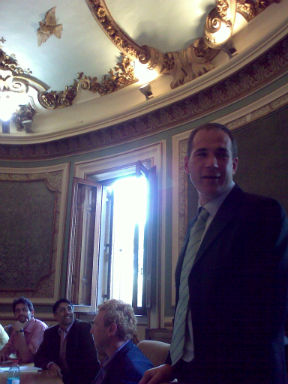
Your editor reports from Rome, Italy, where he attended the meeting of the executive committee of the International Research Network on Religion and Democracy (IRNRD). The meeting was preceded by lectures of Dr Michael Hölzl (Manchester, pictured below giving a brilliant lecture on the temptation of re-mythologising sovereignty), prof Graham Ward (Manchester), and Walter Van Herck (Antwerp). The meeting and lectures were kindly hosted by the LUISS Centre for Ethics and Global Politics and John Cabot University.

30.04.2010-14.08.44_26042010166_288x384.jpg


Let it be known that Rome is certainly one of the great cities of the world and both LUISS and JCU extraordinary academic institutions. The committee meeting was also a success: the IRNRD 2010 conference takes place in Rome under the title "Between Rawls and Religion". The following conference on "Politics and Evil" will meet at the University of Lapland in December 2011 -- i.e. we decided to move the Lapland meeting one year earlier than previously planned.

Thanks again Aakash and Tom for hosting us. Looking forward to working with you again soon.

Mika

Political theology à la Carl Schmitt

What does the political theology in the name of our project stand for? I will try to open the concept by using the ideas of Carl Schmitt.

As Schmitt states in his famous quote 'The central concepts of the modern state theory are all secularized theological concepts' (Politische Theologie, 1922). This is easier to understand if we know Schmitt's view how the controlling forces in the Western states have changed throughout their history. In the medieval worldview states were controlled by God and the Scriptures. Secular politics was a prerogative of the Catholic Church and the Pope who had a mandate straight from God. Now - after the phases of science, humanism and economics - we are living in a state where technology is the ruling element.

If we want to fully understand this analogy between political theory and theology we must study Schmitt's notion about the 'state of exception'. For Schmitt 'sovereign is the one who decides about the exception'. Exception is the miracle and the sovereign (state) is the God of the secularised time. Exceptions made by the sovereign can not be explained by the laws like the miracles made by God can not be explained by rational sense. Political theology tries to find the elements of transcendence which are often concealed in secular politics.

According to Schmitt 'the machine now runs by itself' - all transcendental elements have been stripped off the state. In the modern state the omnipotent God has been replaced by omnipotent lawgiver. Schmitt wants to restore the importance and weight that the concepts of political theory had in the 16th century. Schmitt is very critical towards liberalism and criticises the fragmentation of power. For him a strong state but also strong values were the only ways to face the challenges posed by the liberalising international system.

Even though Schmitt represented his ideas in the first half of 20th century and even thought some of his ideas can be seen as products of his time, are the theories of the political theology and the state of exception getting more attention especially in the context of war on terror.

-Mari

The New Pietism Will Lead to The Same Old Results

The lutheran blog Cyberbrethen posts an interesting tidbit on pietism from a book published two decades ago: The New Pietism Will Lead to The Same Old Results:

‘We do not have to look very far to see that today there is a new spirit of pietism abroad, a pietism that sees the essence of Christianity in the small, informal group, rather than in the total community of faith at worship within a recognized and formal liturgical order. It is a pietism that measures its success by the number of people it touches, rather than by the truth of the message it proclaims. It is a pietism that is preoccupied with ‘simple hymns’ and informal structures of worship. It is a pietism that is impatient with the German Reformation of the sixteenth century, a pietism that asserts that we need new forms and less of the old. It is a new spirit of pietism that looks in many respects like the old pietism, the Pietism in the technical sense which we have considered here. (Bach and Pietism: Similarities Today, by Robin A. Leaver, Concordia Theological Quarterly, 55:1 (Jan. 1991), pp. 5-22.)


(Via Cyberbrethren Lutheran Blog.)


Mika

New book on political theory/political theology

Dear Colleagues,
Hereby I inform you that the book From Political Theory to Political Theology: Religious Challenges and the Prospects of Democracy (Aakash Singh, Péter Losonczi eds.) has been published by Continuum Publishers:

During the last two decades we have witnessed what José Casanova has characterised as “religion going public”. This has not been a trend exclusive to traditionally religious nations. Rather, it has been visible in as diverse environments as that of the construction of the new Russian political identity or in the “post-9/11” political discourses of the USA.

Surprisingly, important religious manifestations also influenced the political discourses in Britain and, more recently, in France. Partly as a consequence of these phenomena an intensive debate is now evolving about the compatibility of the neutrality of liberal democracy in relation to religiously motivated opinions in public discourses, and the conditions under which such religiously driven contributions could viably “go public”.

This book offers a collection of essays on Religion and Democracy which critically discusses the most important questions that characterize these debates at the points of their intersection within political theory, political theology and the philosophy of religion, and considers both the challenges and the prospects of this new era which, following Habermas, one may call post-secular.


All the best, Péter