
Showing posts with label political theology. Show all posts
Showing posts with label political theology. Show all posts
Future of Political Theology
An anthology edited Losonczi, Singh, and yours truly, based on IRNRD's 2009 annual conference in Budapest, outed by Ashgate in January.
0
comments

Political theology in Rome
Your editor reports from Rome, Italy, where he attended the meeting of the executive committee of the International Research Network on Religion and Democracy (IRNRD). The meeting was preceded by lectures of Dr Michael Hölzl (Manchester, pictured below giving a brilliant lecture on the temptation of re-mythologising sovereignty), prof Graham Ward (Manchester), and Walter Van Herck (Antwerp). The meeting and lectures were kindly hosted by the LUISS Centre for Ethics and Global Politics and John Cabot University.
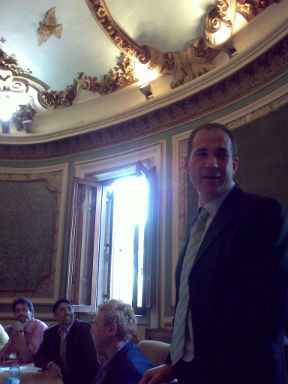
Let it be known that Rome is certainly one of the great cities of the world and both LUISS and JCU extraordinary academic institutions. The committee meeting was also a success: the IRNRD 2010 conference takes place in Rome under the title "Between Rawls and Religion". The following conference on "Politics and Evil" will meet at the University of Lapland in December 2011 -- i.e. we decided to move the Lapland meeting one year earlier than previously planned.
Thanks again Aakash and Tom for hosting us. Looking forward to working with you again soon.
Mika
Political theology à la Carl Schmitt
What does the political theology in the name of our project stand for? I will try to open the concept by using the ideas of Carl Schmitt.
As Schmitt states in his famous quote 'The central concepts of the modern state theory are all secularized theological concepts' (Politische Theologie, 1922). This is easier to understand if we know Schmitt's view how the controlling forces in the Western states have changed throughout their history. In the medieval worldview states were controlled by God and the Scriptures. Secular politics was a prerogative of the Catholic Church and the Pope who had a mandate straight from God. Now - after the phases of science, humanism and economics - we are living in a state where technology is the ruling element.
If we want to fully understand this analogy between political theory and theology we must study Schmitt's notion about the 'state of exception'. For Schmitt 'sovereign is the one who decides about the exception'. Exception is the miracle and the sovereign (state) is the God of the secularised time. Exceptions made by the sovereign can not be explained by the laws like the miracles made by God can not be explained by rational sense. Political theology tries to find the elements of transcendence which are often concealed in secular politics.
According to Schmitt 'the machine now runs by itself' - all transcendental elements have been stripped off the state. In the modern state the omnipotent God has been replaced by omnipotent lawgiver. Schmitt wants to restore the importance and weight that the concepts of political theory had in the 16th century. Schmitt is very critical towards liberalism and criticises the fragmentation of power. For him a strong state but also strong values were the only ways to face the challenges posed by the liberalising international system.
Even though Schmitt represented his ideas in the first half of 20th century and even thought some of his ideas can be seen as products of his time, are the theories of the political theology and the state of exception getting more attention especially in the context of war on terror.
-Mari
IRNRD
Dear Colleagues,
Let me shortly inform you about the activities and some of the plans of the IRNRD (International Research Network on Religion and Democracy): an inter-disciplinary research group of international scholars.
The first steps were made in 2008, when we organized a conference with the title Religion and Democracy: Challenges and Prospects. Our second conference Political Theology for the 21st Century? Trends and Tasks was held in December 2009, where Mika -- an active member of the IRNRD -- gave a presentation on Laestadianism and the project Laestadian-ism: Political Theology and Civil Religion (see Mika's related posts). Our next conference will be in Rome in December this year, a joint program at LUISS University and John Cabot University. The meeting is under organisation with the title Between Rawls and Religion. In cooperation with the Laestedianism project, we plan to organize our 2012 annual conference in Rovaniemi on Politics and Evil.
Members of the advisory board are renowned scholars like Neera Chandhoke, Maeve Cooke, Herman De Dijn, Sebastiano Maffettone, András Lánczi, Johannes van der Ven, while the members and cooperative partners include Aakash Singh, Tom Bailey, András Csepregi, Jianhong Chen, Michael Hoelzl, Patrick Loobuyck, Theo de Wit, William Desmond, John Rundell, Walter van Herck, Peter Jonkers, and Matthias Riedl.
Forthcoming publications of the network: From Political Theory to Political Theology (eds. Péter Losonczi and Aakash Singh, Continuum, 2010) and we are about submitting another piece at LIT Verlag on Habermas' postsecular turn.
We have started working on further pieces based on the presentations of the 2009 conference and additional texts. Mika will be co-editor of a book with theological studies.
We intend to submit applications regarding financing on national and international level and intensify the cooperation in the most diverse forms possible. If you get interested in this initiative do not hesitate and contact me at lospeter at the domain yahoo dot com.
Péter Losonczi
Let me shortly inform you about the activities and some of the plans of the IRNRD (International Research Network on Religion and Democracy): an inter-disciplinary research group of international scholars.
The first steps were made in 2008, when we organized a conference with the title Religion and Democracy: Challenges and Prospects. Our second conference Political Theology for the 21st Century? Trends and Tasks was held in December 2009, where Mika -- an active member of the IRNRD -- gave a presentation on Laestadianism and the project Laestadian-ism: Political Theology and Civil Religion (see Mika's related posts). Our next conference will be in Rome in December this year, a joint program at LUISS University and John Cabot University. The meeting is under organisation with the title Between Rawls and Religion. In cooperation with the Laestedianism project, we plan to organize our 2012 annual conference in Rovaniemi on Politics and Evil.
Members of the advisory board are renowned scholars like Neera Chandhoke, Maeve Cooke, Herman De Dijn, Sebastiano Maffettone, András Lánczi, Johannes van der Ven, while the members and cooperative partners include Aakash Singh, Tom Bailey, András Csepregi, Jianhong Chen, Michael Hoelzl, Patrick Loobuyck, Theo de Wit, William Desmond, John Rundell, Walter van Herck, Peter Jonkers, and Matthias Riedl.
Forthcoming publications of the network: From Political Theory to Political Theology (eds. Péter Losonczi and Aakash Singh, Continuum, 2010) and we are about submitting another piece at LIT Verlag on Habermas' postsecular turn.

We have started working on further pieces based on the presentations of the 2009 conference and additional texts. Mika will be co-editor of a book with theological studies.
We intend to submit applications regarding financing on national and international level and intensify the cooperation in the most diverse forms possible. If you get interested in this initiative do not hesitate and contact me at lospeter at the domain yahoo dot com.
Péter Losonczi
Christmas in the Trenches
Peace from your editor and a classic piece, Christmas in the Trenches, by Jim Wallis:
Mika
We first published this reflection by Jim Wallis in 2002. It has since become our Christmas tradition, kind of our own Charlie Brown Christmas special, if you will. With the ongoing conflicts raging during each passing year, it remains tragically relevant,…

(Via God's Politics Blog.)
Mika
People: good or evil?
Dennis Praeger cuts into the heart of the matter of political theory by asking the perennial question: If You Believe People Are Basically Good or Evil?
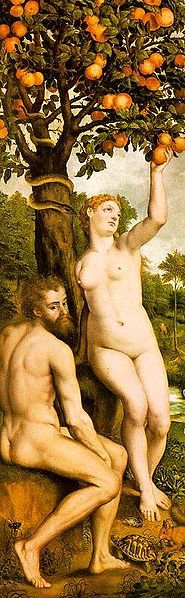
According to Praeger no issue has a greater influence on determining your social and political views than whether you view human nature as basically good or not:
One of these forces is poverty, which explains evil by social deprivation. The fallacy of this explanation is, Praeger points out, that there are people who choose evil for reasons having nothing to do with their economic situation.
He goes on:
This is what religion teaches, at least the Christian religion does. Mankind is with Adam: we are, like St. Paul, "of the flesh, sold under sin" (Rom 7:14, ESV). If there is something wrong with the society, it is not the society: it is us. It is not the structure we must blame, but the agent.
Praeger continues with two more important points, but we already know where he is coming from. I have always admired the eloquence of the conservative genre: conservatives do not need to quote research or theories to make a point. An argument composed in layman's black/white, either/or, friend/enemy terms communicates more than social science ever could.
Where have I read Praeger's question before? In Carl Schmitt's The Concept of the Political, of course:
A theologian ceases to be a theologian, Schmitt argues, when he no longer considers man to be a sinner in need of redemption, no longer distinguishes between the chosen and unchosen. When you first entertain the thought that people can be good, you will soon believe that you yourself are good. Those who disagree with your assessment -- and there will always be someone -- are not merely wrong, but likely to be on the evil's side. Theology works as a bulwark against moral relativism: a stand on God's good against the ideas and ideologies of men.
Praeger finishes off by demolishing the ideological foundations of "secular humanistic culture":
In other words: political society needs God on its side. Where have I read this before? Joseph de Maistre is about as pessimistic when it comes to the faculties of man in taking care of its political institutions. Considerations on France is an attack on Rousseau -- "perhaps the most self-deceived man who ever lived" -- and the revolution he helped inspire. De Maistre abhorred the idea of state apart from the divine:
Though I agree with Praeger when it comes to his (and Schmitt's) anthropological assessment, I find it difficult to bring it into our political context. Both de Maistre and Praeger write in their own political contexts -- Joseph against revolutionary humanism and Dennis against American liberalism -- and their conclusions have little to contribute to, say, Finland in the current political moment. What (or who) is evil in Finnish society? Is God on Finland's side, and if indeed he is, who are the Finns exactly? If not on "our" side, whose side is God on?
(Via Apologetic Junkie.)
Mika
According to Praeger no issue has a greater influence on determining your social and political views than whether you view human nature as basically good or not:
I believe that we are born with tendencies toward both good and evil. Yes, babies are born innocent, but not good. Why is this issue so important? First, if you believe people are born good, you will attribute evil to forces outside the individual.
One of these forces is poverty, which explains evil by social deprivation. The fallacy of this explanation is, Praeger points out, that there are people who choose evil for reasons having nothing to do with their economic situation.
He goes on:
Second, if you believe people are born good, you will not stress character development when you raise children. [...] You will teach them how to struggle against the evils of society -- its sexism, its racism, its classism and its homophobia. But you will not teach them that the primary struggle they have to wage to make a better world is against their own nature.
This is what religion teaches, at least the Christian religion does. Mankind is with Adam: we are, like St. Paul, "of the flesh, sold under sin" (Rom 7:14, ESV). If there is something wrong with the society, it is not the society: it is us. It is not the structure we must blame, but the agent.
Praeger continues with two more important points, but we already know where he is coming from. I have always admired the eloquence of the conservative genre: conservatives do not need to quote research or theories to make a point. An argument composed in layman's black/white, either/or, friend/enemy terms communicates more than social science ever could.
Where have I read Praeger's question before? In Carl Schmitt's The Concept of the Political, of course:
One could test all theories of state and political ideas according to their anthropology and thereby classify these as to whether they consciously or unconsciously presuppose man to be by nature evil or by nature good. [...] The problematic or unproblematic conception of man is decisive for the presupposition of every further political consideration, the answer to the question whether man is a dangerous being or not, a risky or harmless creature. (58.)
A theologian ceases to be a theologian, Schmitt argues, when he no longer considers man to be a sinner in need of redemption, no longer distinguishes between the chosen and unchosen. When you first entertain the thought that people can be good, you will soon believe that you yourself are good. Those who disagree with your assessment -- and there will always be someone -- are not merely wrong, but likely to be on the evil's side. Theology works as a bulwark against moral relativism: a stand on God's good against the ideas and ideologies of men.
Praeger finishes off by demolishing the ideological foundations of "secular humanistic culture":
No great body of wisdom, East or West, ever posited that people were basically good. This naive and dangerous notion originated in modern secular Western thought, probably with Jean Jacques Rousseau, the Frenchman who gave us the notion of pre-modern man as a noble savage. He was half right. Savage, yes, noble, no. If the West does not soon reject Rousseau and humanism and begin to recognize evil, judge it and confront it, it will find itself incapable of fighting savages who are not noble.
In other words: political society needs God on its side. Where have I read this before? Joseph de Maistre is about as pessimistic when it comes to the faculties of man in taking care of its political institutions. Considerations on France is an attack on Rousseau -- "perhaps the most self-deceived man who ever lived" -- and the revolution he helped inspire. De Maistre abhorred the idea of state apart from the divine:
It would be curious to examine our European institutions one by one and to show how they are all Christianized, how religion mingles in everything, animates and sustains everything. Human passions may pollute and even pervert primitive creations, but if the principle is divine, this is enough to give them a prodigious permanence. (42.)
Though I agree with Praeger when it comes to his (and Schmitt's) anthropological assessment, I find it difficult to bring it into our political context. Both de Maistre and Praeger write in their own political contexts -- Joseph against revolutionary humanism and Dennis against American liberalism -- and their conclusions have little to contribute to, say, Finland in the current political moment. What (or who) is evil in Finnish society? Is God on Finland's side, and if indeed he is, who are the Finns exactly? If not on "our" side, whose side is God on?
(Via Apologetic Junkie.)
Mika
Eating, drinking and sleeping political theology
The International Research Network on Religion and Democarcy (IRNRD) held its annual conference on 14.-15.12.2009 at the Corvinus University in Budapest, Hungary. The theme of the conference was Political Theology for the 21st Century: Trends and Tasks. Among speakers invited were Lieven Boeve (Catholic University Leuven), Michael Hoelzl (University of Manchester), Peter Jonkers (Tilburg University), András Lánczi (Corvinus University) and Theo de Wit (Tilburg University). I gave a talk on the laestadian movement in Finland and presented an outline of our research project.
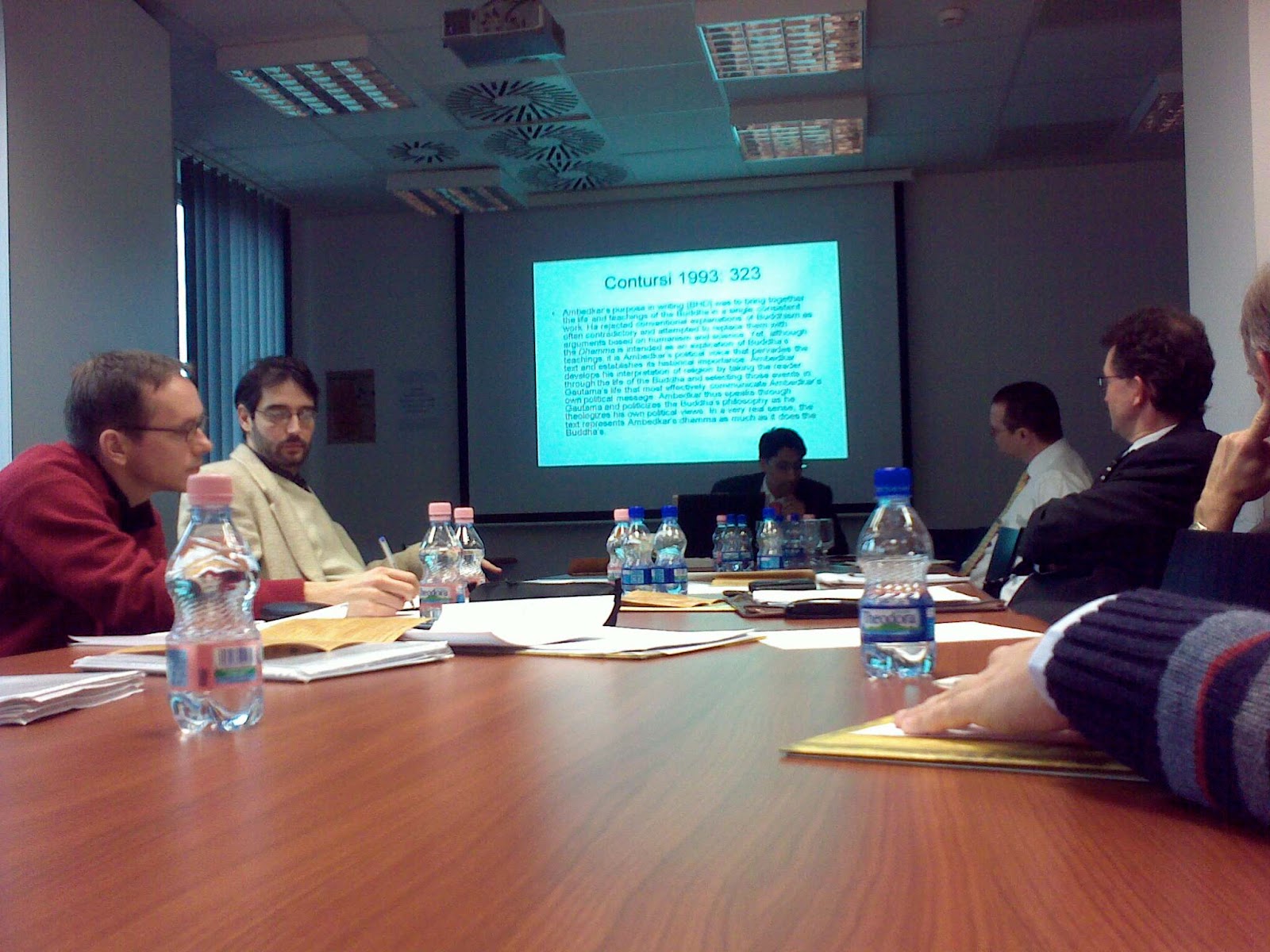 From the left: Tom Bailey (John Cabot University), Peter Losonczi (University of West Hungary), Aakash Singh (LUISS University Rome), David Tombs (Irish School of Ecumenics, Trinity College Dublin), Lieven Boeve, Peter Jonkers and the hand of Domenico Melidoro (LUISS University, Rome).
The venue of the conference was faithful to its theme. The participants stayed at Kálvin Ház -- A hotel in downtown Budapest I can warmly recommend -- and the conference dinner was served in Spinoza Restaurant:
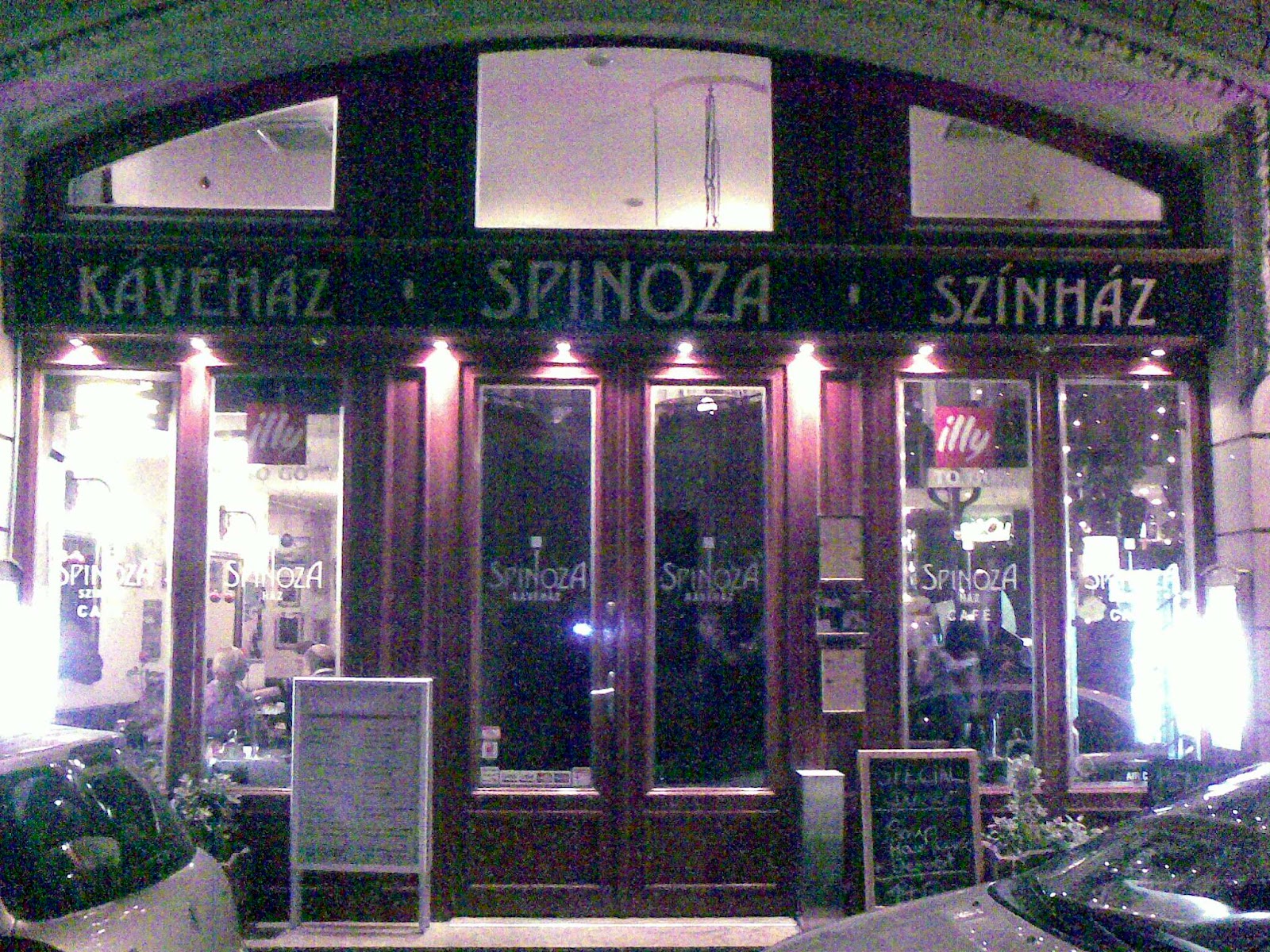
Well done by the organizers! Corvinus University itself was originally established to honour Karl Marx, whose politico-theological relevance may appear less obvious.
My first meeting with the network can only be described as a massive succé! It was indeed a privilege to work with such an esteemed line-up of colleagues. My notes are rich with interesting excursions into new political theologies and intriguing ideas to work with over the next couple of years. Thanks again for Peter Losonczi and Akaash Singh for their effort and for inviting me along. Next year’s meeting will be held in Rome and we are planning to bring the network to Rovaniemi in 2011 or 2012. Excellent stuff!
Mika
From the left: Tom Bailey (John Cabot University), Peter Losonczi (University of West Hungary), Aakash Singh (LUISS University Rome), David Tombs (Irish School of Ecumenics, Trinity College Dublin), Lieven Boeve, Peter Jonkers and the hand of Domenico Melidoro (LUISS University, Rome).The venue of the conference was faithful to its theme. The participants stayed at Kálvin Ház -- A hotel in downtown Budapest I can warmly recommend -- and the conference dinner was served in Spinoza Restaurant:
Well done by the organizers! Corvinus University itself was originally established to honour Karl Marx, whose politico-theological relevance may appear less obvious.
My first meeting with the network can only be described as a massive succé! It was indeed a privilege to work with such an esteemed line-up of colleagues. My notes are rich with interesting excursions into new political theologies and intriguing ideas to work with over the next couple of years. Thanks again for Peter Losonczi and Akaash Singh for their effort and for inviting me along. Next year’s meeting will be held in Rome and we are planning to bring the network to Rovaniemi in 2011 or 2012. Excellent stuff!
Mika
Political Theology in Budapest, December 2009
On 14--15 December your host will attend an international conference at the Corvinus University in lovely Budapest. Political Theology for the 21st Century is the title of the meeting and it is organized by the International Research Network on Religion and Democracy (IRNRD).
 Looking at the program I will give a talk about our project on Laestadian-ism on Monday and chair a panel on Tuesday. Our partner Péter Losonczi, a college associate professor at the West Hungarian University (Szombathely), will present a paper on Johann Baptist Metz's categories for a politics of peace on Monday. Hopefully we will get a chance to talk about project collaboration and come up with a plan to bring Peter to Lapland!
Mika
Subscribe to:
Posts (Atom)


 Posts

